
CASE STUDY -> DEFENCE & NAVAL SYSTEMS
Engineering multi-mode lethality, safety architecture, and cross-caliber adaptability into a single compact naval artillery fuze — from 76mm to 127mm.
01 — Context
Naval gun systems must engage radically different targets — a fast-moving aircraft at altitude, a sea-skimming anti-ship missile at wave-top height, and a surface vessel at range. Traditional fuzes are optimised for one threat class. This project required a single, compact fuze architecture capable of performing reliably across all three.
Mode — Proximity
High-speed inbound aircraft and projectiles. The RF proximity sensor detects approach vector and fires at optimised standoff distance for maximum fragmentation coverage.
Mode — Proximity
Anti-ship missiles flying at wave-top altitude. The hardest detection problem — the fuze must discriminate between ocean clutter and a valid target at high closure speed and very low altitude.
Mode — Direct Action
Ships, coastal emplacements, and hardened structures. Direct Action mode detonates on physical impact, delivering maximum penetrating energy before initiation.
The fuze operates across 76mm, 100mm, and 127mm caliber ammunition, meaning a single electronics architecture must adapt to three distinct ballistic profiles, muzzle velocities, and gun-launch setback forces — without compromising timing or safety.
02 — The Core Challenge
Each performance requirement pulls the design in a different direction. The engineering problem is not optimisation — it is arbitration between competing demands that each challenge the others.
01
The RF sensor must be sensitive enough to reliably detect a sea-skimming missile at wave height — yet selective enough to reject ocean clutter, spray, and surface reflections at high sea states. A false trigger at deck level is catastrophic.
02
The fuze must arm quickly enough to be effective at close-range engagements, while ensuring absolute safety during handling and magazine storage on a live warship deck — under shock, vibration, and salt spray.
03
A single electronics platform must adapt to 76mm, 100mm, and 127mm rounds — each with distinct ballistic characteristics and launch setback forces — without compromising detonation timing accuracy across the range.
04
Reserve battery chemistry, RF circuit components, and mechanical safety devices must all remain within specification after a decade in naval magazine storage — through temperature cycling, humidity extremes, and continuous mechanical vibration.
Key implication: This is not a sensor performance problem. It is an architectural integration problem. The fuze’s value is not in any single component, it is in the mode arbitration logic that makes all three operate correctly from a shared electronics platform.
03 — System Architecture
Every subsystem has a defined and non-negotiable role in the initiation chain. No single component failure should be able to produce an unsafe outcome.
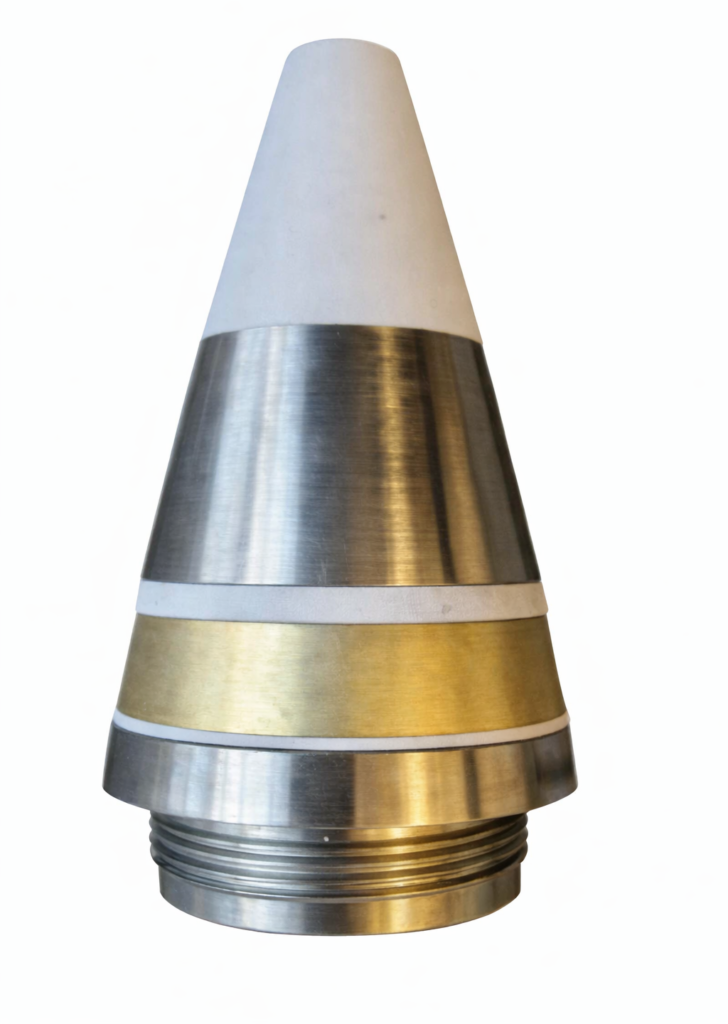
The fuze integrates a compact RF sensor assembly, a mechanical Safety and Arming Device (SAD), an electronic gating layer, and a reserve-type battery into a package engineered to survive gun-launch setback and decade-long magazine storage simultaneously.
The mechanical SAD physically blocks the initiation path until arming conditions — defined setback force and spin rate — are met after launch. The electronic gate provides a second independent layer: even if the mechanical device misfunctions, the electronics will not issue a fire command unless its own arming criteria are satisfied.
The reserve battery is inert during storage and activates only under the mechanical force of launch, ensuring no electrical power reaches any circuit during handling, transport, or loading.
Sensing Principle
RF Proximity
Operating Modes
Proximity / DA / Self-Destruct
Compatibility Calibers
76 / 100 / 127 mm
Power Source
Reserve Type
Safety Architecture
Mech. SAD + Electronic Gate
Shelf Life
≥ 10 Years
Environmental Rating
Naval — Shock, Vibration, Marine
Intended Targets
Aerial / Sea-Skimmer / Surface
04 — Initiation Chain
A precisely sequenced pipeline ensures every detonation is both intentional and tactically optimal. Each gate must clear before the next step can proceed.
1
Setback force activates reserve battery and begins mechanical SAD arming sequence under defined setback and spin conditions.
2
Compact RF sensor begins emitting and scanning. Electronic gate enables proximity mode once safe arming distance is confirmed cleared.
3
Return signal crosses threshold. Mode arbitration confirms proximity or DA engagement based on target signature and flight envelope.
4
Fire command issued at optimal standoff or on impact. Self-Destruct triggers automatically if no target is detected within the programmed flight envelope.
Self-Destruct mode: If no valid target is detected within the engagement envelope, the fuze initiates independently. This is not a fallback — it is a primary safety mechanism preventing live rounds from entering the water or civilian zones on a miss.
05 — Engineering Posture
Dual-layer safety — mechanical and electronic — ensures no single failure results in premature detonation. Defense-in-depth is not a feature; it is the foundation of the design.
Proximity, Direct Action, and Self-Destruct modes share a single electronics platform. Mode arbitration logic is the core IP — not the sensor alone.
Electronics adaptable to three calibers means the development investment scales across multiple naval gun systems, reducing per-unit cost and integration risk for shipbuilders.
Marine conditions, gun-launch setback, and decade-long storage were not late-stage considerations — they shaped every component selection and packaging decision from day one.
From strategy to execution, we partner with you to design, develop, and deliver software that solves real problems and scales with your business.


Über der Glonn 11, 85238 Petershausen