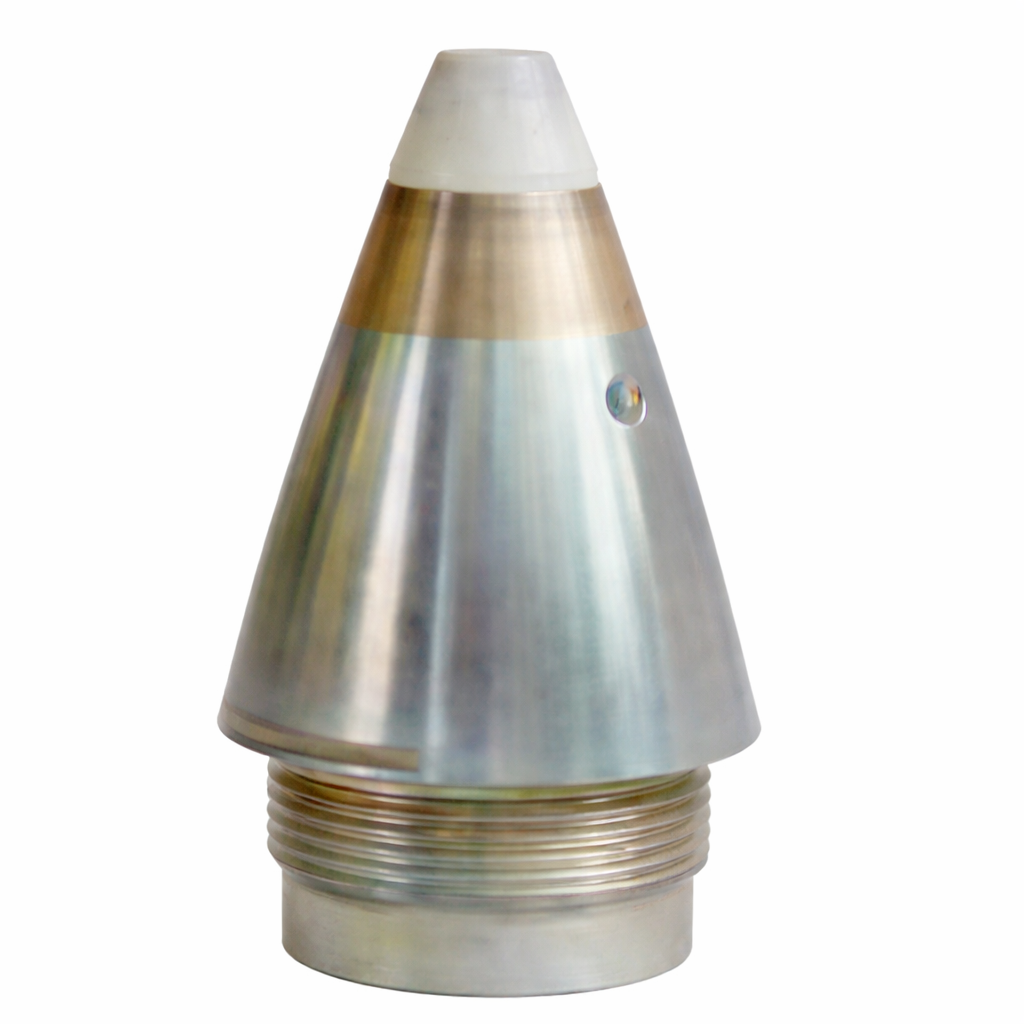
CASE STUDY -> DEFENCE & NAVAL SYSTEMS
A dual-mode electronic artillery fuze for 155mm ammunition — engineered to switch between immediate surface detonation and programmable post-impact delay, adapting lethality to target type on demand.
01 — Context
The 155mm PD–PID Fuze is a modern, electronically controlled artillery fuze designed for high-accuracy functioning in Point Detonating (PD) and Post-Impact Delay (PID) modes. Its dual-mode capability enhances effectiveness against soft targets, structures, and light fortifications — ensuring optimal energy transfer on delayed detonation when required.
Mode A
Immediate initiation on impact. The fuze fires at the moment of surface contact, delivering maximum blast effect at the point of impact.
Effective against: Soft targets
Mode B
Short delay after impact for enhanced behind-target effects. The fuze waits a controlled period before detonating — placing the blast event inside or behind the target.
Effective against: Structures, light fortifications
02 — The Core Challenge
The system integrates advanced sensing, safety, timing, and firing electronics into a compact module — all of which must survive the extreme mechanical forces of artillery launch before performing with precision.
01
The fuze is resilient to the high launch stresses typically experienced in artillery guns — setback, spin, and shock. All electronics and mechanical safety components must survive these forces and function correctly immediately after.
02
The fuze incorporates an electronic fuze module with digital timing, impact/contact sensing, and firing control — all integrated into a compact, compatible module for standard artillery shells.
03
Temperature, vibration, and shock tolerance suitable for field deployment. The fuze is engineered to remain within specification across the full range of field storage and operational conditions.
04 — Initiation Chain
Every stage of the firing sequence is gated. No step can proceed unless the previous stage has confirmed its conditions — this is how safety and timing precision are maintained from the magazine to the target.
1
PD or PID mode is selected prior to loading. In advanced versions, digital timing parameters are programmed at the gun position for the specific target type.
2
Firing activates the reserve battery. Setback force and spin rate trigger the mechanical S&A arming sequence. Electronic interlocks independently confirm arming conditions.
3
Contact sensor detects target strike. In PD mode, the firing command is issued immediately. In PID mode, the digital timer begins at the moment of confirmed impact.
4
PD fires instantly on contact. PID fires after the programmed delay — timed to detonate inside the target. Self-Destruct fires if no impact is detected in flight.
03 — System Architecture
The system integrates advanced sensing, safety, timing, and firing electronics into a compact module compatible with standard artillery shells.
The Mechanical S&A (Safety and Arming Device) combined with electronic interlocks provides the dual-layer safety architecture — physically blocking the initiation path until defined arming conditions are met, with an independent electronic gate as a second layer.
The reserve-type battery is activated at the moment of firing, ensuring the fuze carries no live electrical energy during storage, transport, or loading.
The Self-Destruct logic is an electronic feature that ensures safety if no impact occurs — the fuze initiates automatically if the engagement envelope is completed without a target strike.
Platform
155mm Artillery Shell
Operating Modes
PD / PID
Fuze Module
Digital timing + Impact Sensing + Firing Control
Safety Architecture
Mech. S&A + Electronic Interlocks
Self-Destruct
Electronic — Auto Trigger (no impact)
Power Source
Reserve Battery (Activated at Firing)
Environment
Field — Temp, Vibration, Shock
Digital timing advantage: Replacing mechanical delay elements with digital timing circuits eliminates the tolerance accumulation and temperature sensitivity that legacy mechanical delay fuzes carry. The delay window is precisely repeatable across the full range of field temperatures and across the service life of the fuze.
05 — Engineering Posture
Sensing, timing, safety, and firing control are integrated into a single compact electronics module — not assembled from separate legacy components. This integration is the core of the product’s design approach.
Mechanical S&A and electronic interlocks provide two independent safety layers. No single failure produces an armed fuze in an unsafe condition. Both must be satisfied before the initiation path is cleared.
Compatibility with standard 155mm shell bodies means the fuze integrates into existing supply chains and logistics without requiring changes to ammunition or gun system procurement.
From strategy to execution, we partner with you to design, develop, and deliver software that solves real problems and scales with your business.


Über der Glonn 11, 85238 Petershausen